

Quick answer: To outsource lead generation, define your ideal customer, choose a delivery model (virtual assistant, SDR, or agency), set measurable KPIs, share your tools and scripts, run a 30-day pilot, and review results every week. Most growing businesses start with a dedicated lead generation assistant and scale once their cost per lead is proven.
Every business needs a steady flow of qualified prospects. But hiring, training, and managing an in-house sales development team takes months and a serious budget. That is why more founders, agencies, and service companies now outsource lead generation to trained specialists who already know the tools, data sources, and outreach channels.
In this guide, you will learn how to outsource lead generation without wasting money or losing control of your brand. You will see the full process, typical cost structures, common mistakes, the KPIs that matter, and clear answers to the questions buyers ask most.
What Does It Mean to Outsource Lead Generation?
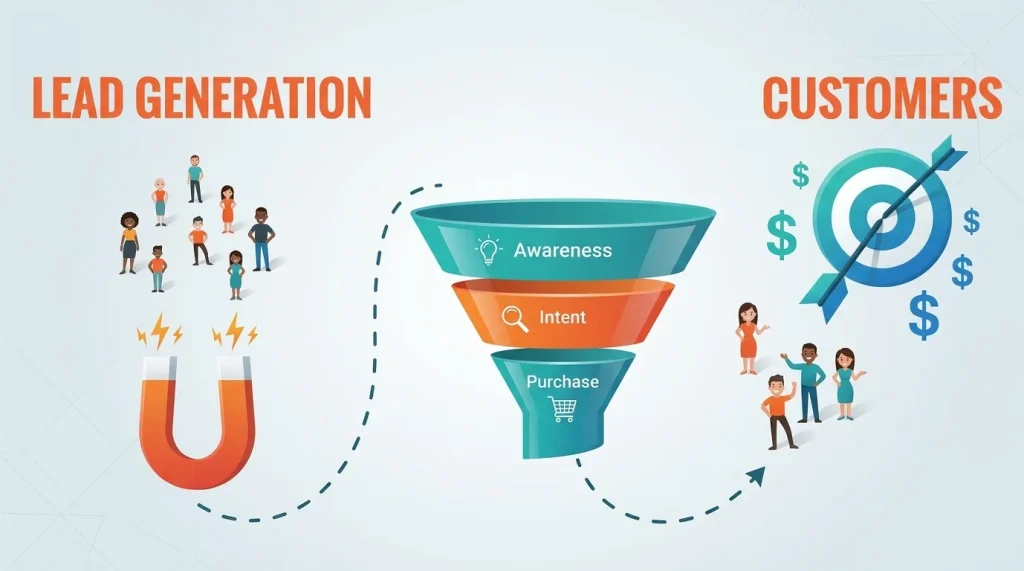
When you outsource lead generation, you hand the top-of-funnel work to an external person or team. They research prospects, build contact lists, send cold emails, make calls, run LinkedIn outreach, and book qualified meetings for your sales team. You keep control of strategy, pricing, and closing. They handle the repetitive, time-heavy prospecting work.
There are three common models:
- Virtual assistants: Affordable and flexible. They handle list building, data research, first-touch outreach, and CRM data entry.
- Outsourced SDRs: Trained sales development reps who qualify leads and book appointments. You can choose a sales development rep or a US-based SDR for markets where accent and time zone matter.
- Agencies: Full-service teams that manage strategy, data, copy, and reporting. They usually cost the most.
Why Do Businesses Outsource Lead Generation?
Companies choose this route for five practical reasons:
- Lower cost: No recruiting fees, benefits, equipment, or long training periods.
- Faster start: Specialists arrive with scripts, workflows, and tool experience.
- Better focus: Your closers spend their time selling instead of searching for prospects.
- Flexibility: You can scale hours up or down with a part-time monthly package or a pay-as-you-go plan.
- Consistency: Daily outreach continues even when your internal team is busy with deals.
Companies that outsource lead generation usually ramp up faster because they skip the hiring and training phase. The trade-off is that you must brief your partner clearly and review performance often.
Step-by-Step: How to Outsource Lead Generation
Step 1: Define Your Ideal Customer Profile
Write down the industry, company size, job titles, location, pain points, and budget signals of your best buyers. The clearer your profile, the better your leads will be. Add examples of past best customers and a “do not contact” list so your partner avoids existing clients and competitors.
Step 2: Set Clear Goals and KPIs
Decide what success looks like: booked meetings, qualified leads, cost per lead, or pipeline value. A good goal is specific, such as “20 qualified meetings per month at an agreed cost per meeting.” Without numbers, you cannot judge whether your investment is working.
Step 3: Choose the Right Outsourcing Model
Before you outsource lead generation, match the model to your budget and sales cycle:
- Tight budget, simple outreach: a virtual assistant
- Phone-heavy, fast follow-up: an outbound calling agent
- Spanish-speaking markets: a bilingual English-Spanish SDR
- Complex B2B sales: a dedicated SDR
- Full campaign strategy: an agency
Step 4: Vet Your Partner Carefully
Ask for case studies, sample scripts, a sample report, data-privacy practices, and a replacement policy. Review proof of results, such as client case studies, and look for experience in your industry. Also ask how contacts are sourced and verified, and how the team follows CAN-SPAM, GDPR, and do-not-call rules.
Step 5: Prepare Tools, Scripts, and Access
Give your partner access to your CRM, email domain, dialer, and LinkedIn tools. Share your pitch, objection handling notes, email templates, and qualification criteria. The better your documents, the faster they perform.
Step 6: Run a 30-Day Pilot
Start small. Test one audience, one offer, and two channels, such as email plus LinkedIn. Many providers offer a free trial, which lets you check quality before you commit to a longer contract.
Step 7: Onboard, Train, and Communicate
Set a weekly call, a shared dashboard, and a Slack or WhatsApp channel for quick questions. Give feedback on lead quality every week. Update scripts when prospects raise new objections. Treat your partner like a team member, not a vendor.
Step 8: Measure, Optimize, and Scale
Review reply rate, meetings booked, show-up rate, and lead-to-deal conversion every week. Cut channels that do not work and double down on those that do. Once results are stable, add support such as a digital marketing assistant to warm up prospects with content and ads.
How Much Does It Cost to Outsource Lead Generation?
Costs depend on the model, region, and experience level. In general:
- Virtual assistants are the most affordable, usually billed hourly or as a monthly flat fee.
- SDRs sit in the middle, typically on a monthly retainer.
- Agencies are the most expensive, often combining a retainer with per-meeting fees.
| Model | Typical Billing | Cost Level | Watch Out For |
|---|---|---|---|
| Virtual assistant | Hourly or monthly flat fee | Most affordable | Define tasks clearly |
| SDR (Sales Development Rep) | Monthly retainer | Mid-range | Agree on targets and reporting |
| Agency | Retainer plus per-meeting fees | Most expensive | Extra fees can add up |
| Pay-per-lead | Fee for each lead | Looks cheap | Rewards volume over quality |
Watch out for pay-per-lead pricing. It looks cheap but can reward volume over quality. Whatever model you pick, ask exactly what counts as a “qualified” lead. You can compare transparent options on the pricing page before you decide.

In-House vs. Outsourced Sales Prospecting
| Factor | In-House Team | Outsourced Team |
| Time to start | Months (hire + train) | Days to weeks |
| Cost structure | Salary, benefits, tools | Flat fee or flexible hours |
| Scalability | Slow | Fast |
| Management load | Heavy | Light to moderate |
| Control | Full | Shared, with clear reporting |
For most growing teams, the decision to outsource lead generation comes down to speed, flexibility, and focus.
Common Mistakes When You Outsource Lead Generation
- A vague ideal customer profile. Weak targeting creates weak leads.
- No KPIs. If nobody defines success, nobody can deliver it.
- Unverified lists. Bad data damages your sender reputation.
- Slow follow-up. Leads go cold within hours, so your sales team must respond quickly.
- Ignoring compliance. Email, calling, and privacy laws vary by country.
- Judging too early. Give each test at least a few weeks of data.
- No CRM discipline. If leads are not logged properly, you lose visibility and accountability.
Which Industries Benefit Most?
Almost any B2B or high-ticket local business can outsource lead generation when the offer is clear. Common examples include real estate, home services, financial services, professional services, and technology companies. You can browse more options on the industries page.
Signs It Is Time to Outsource Lead Generation
- Your pipeline is inconsistent from month to month.
- Founders or senior reps still do their own prospecting.
- Your sales team spends more time researching than talking to buyers.
- You have a proven offer but not enough conversations.
- You want to test a new market without hiring a full team.
If two or more of these sound familiar, a short pilot is a low-risk next step. Explore the full range of sales development support and marketing support to see what fits.
Frequently Asked Questions
What is the best way to outsource lead generation?
Start with a clear ideal customer profile and measurable KPIs. Choose the model that matches your budget, run a 30-day pilot, and review results weekly. Scale only after cost per qualified lead is stable.
Is it worth it to outsource lead generation?
Yes, in most cases. It reduces hiring time and fixed costs, and it lets your sales team focus on closing. It works best when your offer is clear and you give your partner good scripts and fast feedback.
How long does it take to see results?
Early replies and meetings can appear within the first few weeks. A reliable pipeline usually takes 60 to 90 days of testing and optimization, depending on your sales cycle.
What should I look for in a lead generation partner?
Look for relevant case studies, transparent reporting, verified data sources, compliance knowledge, and a trial or pilot option.
Can small businesses afford this?
Yes. Flexible plans, such as hourly or part-time packages, let small teams start with a small budget and grow as results come in.
