
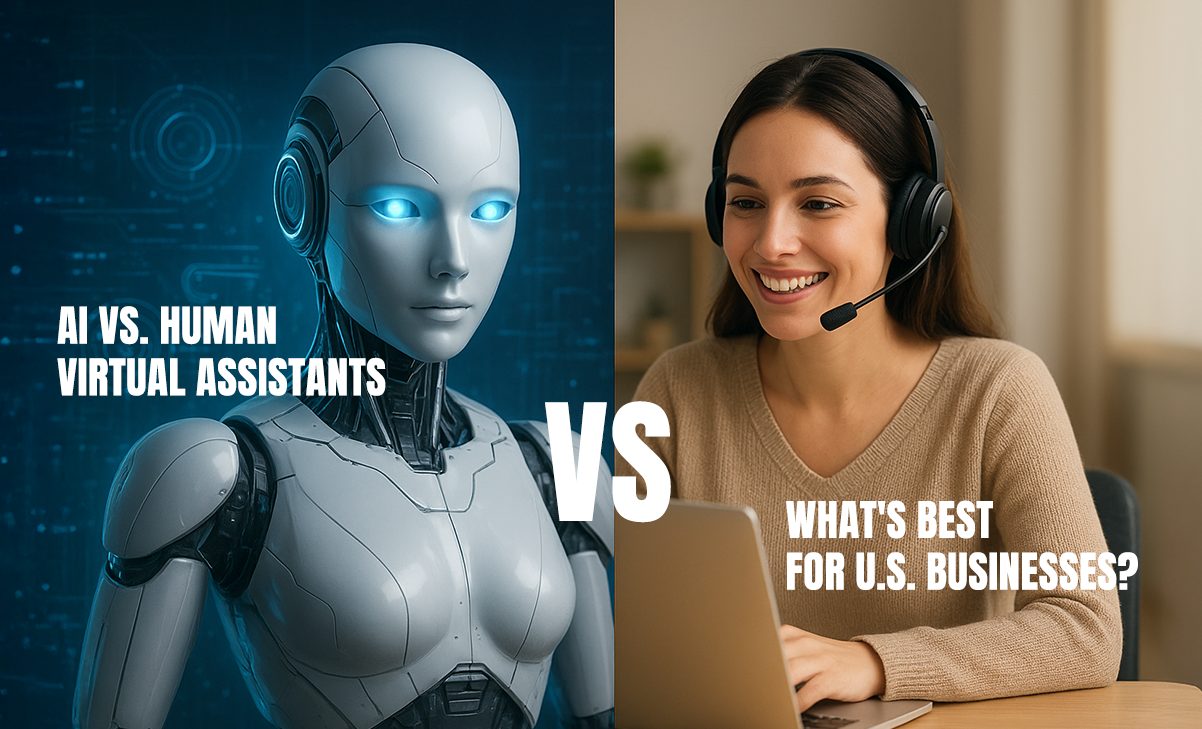
Quick answer:
A virtual assistant is a human professional who owns tasks, uses judgment, and follows through without supervision. An AI assistant is software that executes a single request the moment you ask, but has no accountability and cannot manage ambiguity. Most growing businesses in 2026 get the best results from a hybrid model: a managed virtual assistant who uses AI tools to work faster.
If you’ve searched “virtual assistant vs AI assistant” hoping for a simple answer, you’re not alone. Google search interest in “AI assistant” now outpaces “virtual assistant” by roughly 2.7x, and the crossover happened back in March 2025—a sign of how fast the conversation has shifted. But interest isn’t the same as fit. Before you hand your inbox, calendar, or customer support line to a chatbot (or a new hire), it helps to understand exactly what each option is built to do, where each one breaks down, and how to tell which one your business actually needs.
Virtual Assistant vs AI Assistant: The Core Difference

IBM’s research team makes the clearest technical distinction: a virtual assistant (as AI software) is reactive—it responds to a user’s request and executes one task at a time. It waits to be asked. A human virtual assistant is also responsive to your requests, but that’s where the similarity ends. A human VA applies context, catches mistakes before they become client-facing problems, negotiates with vendors, prioritizes competing deadlines, and takes ownership of an outcome – not just an output (IBM).
Here’s the distinction in practice:
| Human Virtual Assistant | AI Assistant | |
|---|---|---|
| What it is | A trained remote professional | Software (chatbot, AI receptionist, copilot) |
| How it works | Applies judgment, manages relationships, follows through | Executes a single request when prompted |
| Best for | Calendar/inbox management, client communication, research, ops, complex or evolving tasks | High-volume, repetitive, rule-based tasks with low error cost |
| Accountability | A named person you can hold responsible | None — errors need a human to catch them |
| Cost model | Hourly/monthly for labor and expertise | Free to a few hundred dollars/month for software |
| Handles ambiguity | Yes | Poorly, without a human reviewing output |
What a Virtual Assistant Does Well?
A skilled virtual assistant is built for the parts of your business that don’t fit neatly into a script. That typically includes:
- Calendar and inbox management – triaging what’s urgent, what can wait, and what needs your personal reply
- Client and customer communication – reading tone, de-escalating frustration, and representing your brand voice
- Research and reporting – pulling information from multiple sources and synthesizing it into a decision-ready summary
- Cross-functional operations – coordinating between departments, vendors, or contractors without dropping details
- Judgment calls – knowing when a task needs to be escalated to you versus handled independently.
This is why, even as AI tools have matured, the global virtual assistant market is still projected to grow from roughly $19.6 billion in 2025 toward the $80 billion range by 2030 – businesses aren’t replacing human support; they’re upgrading how it works.
What an AI Assistant Does Well (and Where It Breaks Down)
AI assistants – think AI receptionists, scheduling bots, and customer service chatbots – genuinely excel at narrow, high-volume, well-defined work:
- Answering frequently asked questions instantly, 24/7
- Formatting data, generating first drafts, and summarizing documents
- Routing simple requests without waiting on a human’s schedule
- Running the same process thousands of times without fatigue
The cost gap is real: Gartner has pegged the cost per AI-handled interaction at roughly $0.70 versus $8.01 for a human-handled one – an 11x difference. That math looks compelling until you factor in what happens when the request falls outside the script.
This is where “AI vs human support” stops being theoretical. Gartner’s own research team has warned the market about “agent washing” – vendors rebranding basic chatbots and automation as autonomous “AI agents” without the underlying capability to back it up. Gartner estimates that only about 130 of the thousands of vendors claiming agentic AI capabilities are genuinely delivering it, and the firm predicts more than 40% of agentic AI projects will be canceled by the end of 2027 because of unclear value, rising costs, and inadequate oversight (Gartner). In other words: not every “AI assistant” pitched to you in 2026 can actually do what its marketing claims.
Even where AI performs well, oversight still matters. McKinsey’s 2025 State of AI research found that the organizations getting the most value from AI – its “high performers” – are far more likely than others to have defined processes for human review of AI output before it reaches a customer (McKinsey). Software without a human backstop is a liability waiting for the wrong edge case.
The Hybrid VA + AI Model: What’s Actually Winning in 2026
The businesses seeing the best results this year aren’t choosing sides. They’re combining both:
- The human virtual assistant owns the outcome – the relationship, the judgment calls, the final quality check.
- AI tools accelerate the execution – drafting emails, researching competitors, organizing data, and handling first-pass work in seconds.
- The VA reviews and delivers – catching AI errors before they reach your customers and applying the context AI doesn’t have.
Think of it less as “human or robot” and more as a human expert who uses AI to work several times faster than they could alone. You get the speed of automation with someone accountable for the result – which is exactly the model our virtual assistants are trained to run.
How to Decide: Virtual Assistant, AI Assistant, or Both?
Ask yourself these three questions:
- Does the task require judgment or a relationship? If a client, patient, or lead is involved, or the “right answer” depends on context, lean human.
- Is the cost of an error low or high? Drafting a social post is low-stakes. Sending an incorrect invoice or mishandling a HIPAA-covered patient record is not.
- Does the workload change day to day, or is it identical every time? Repetitive, rule-based, high-volume tasks are where a pure AI assistant earns its cost advantage.
If you answered “human” or “high stakes” to any of the above, a managed, AI-augmented virtual assistant is almost always the safer and more scalable choice – because you get a person accountable for the outcome, backed by the same AI tools doing the heavy lifting behind the scenes.
Frequently Asked Questions
Is an AI assistant the same as a virtual assistant?
No. An AI assistant is software that reacts to a single request at a time with no accountability for the outcome. A virtual assistant is a human professional who manages ongoing tasks, uses judgment, and takes ownership of results – often while using AI tools to work faster.
Will AI replace virtual assistants in 2026?
No. Industry data shows AI is expanding what virtual assistants can accomplish rather than replacing them-VAs who use AI tools complete more work per hour, not losing their jobs to it. AI still lacks the accountability, empathy, and judgment that human support requires for anything beyond a scripted task.
Is an AI assistant cheaper than a virtual assistant?
On a per-interaction basis, yes – AI tools can cost a fraction of a human-handled task. But that comparison only holds for simple, repetitive, low-stakes requests. Once errors, escalations, and missed context enter the picture, the “cheaper” option often costs more in cleanup and lost trust.
What’s the difference between an AI assistant and an AI receptionist?
An AI receptionist is a specific type of AI assistant built to answer calls, route inquiries, and handle basic scheduling. Like other AI assistants, it’s reactive and works best for high-volume, predictable interactions – not for tasks that require judgment or relationship management.
How do I know if my business needs a human VA or an AI tool?
If the task involves client relationships, ambiguous instructions, or a high cost of error, a human virtual assistant is the safer fit. If the task is repetitive, rule-based, and low-stakes, an AI tool can likely handle it – ideally with a VA reviewing the output.
Conclusion
The “virtual assistant vs AI assistant” debate isn’t really about picking a side – it’s about matching the right tool to the right task. AI assistants are fast and cheap for narrow, repetitive work. Human virtual assistants bring the judgment, accountability, and follow-through that AI still can’t replicate. For most founders and growing teams, the winning move is a managed virtual assistant who uses AI to multiply their output – not a bot working alone.
Ready to see the difference a managed, AI-augmented virtual assistant makes? Explore our virtual assistant services or claim your free trial to get matched with a vetted top VA this week. Want to see our pricing first? Check out our plans or learn more about how we vet our talent.
