
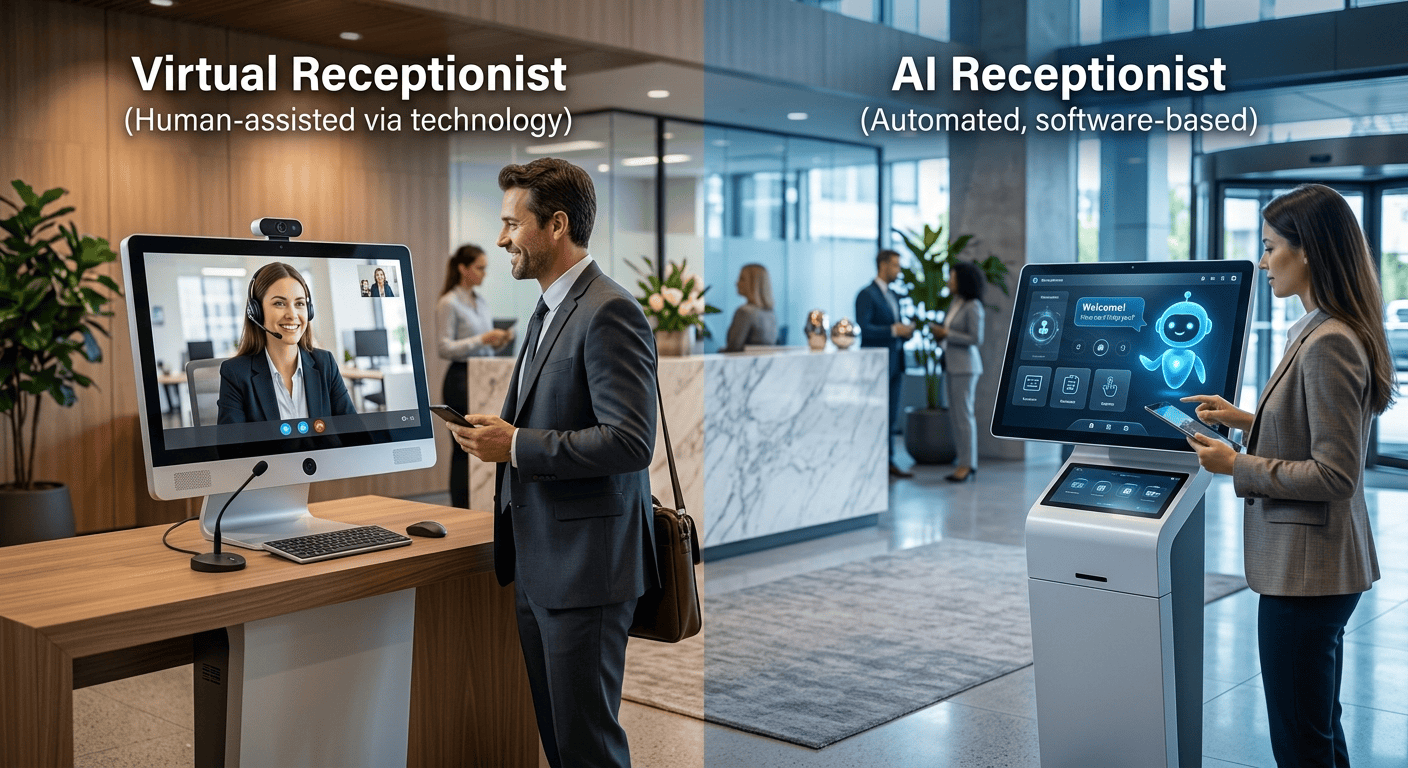
A virtual receptionist is a trained human professional who answers your business calls remotely, greets callers by your company name, takes messages, books appointments and routes urgent calls. An AI receptionist is software that uses voice AI to answer calls automatically. In the virtual receptionist vs AI receptionist decision, choose a virtual receptionist when callers need empathy, judgment and a personal touch. Choose an AI receptionist when you get high volumes of simple, repetitive calls. Many businesses get the best results by combining both.
Missed calls mean missed customers. Whether you run a clinic, a law firm, a real estate agency or an online store, the way you answer the phone shapes how people see your brand. In this guide, Top Virtual Assistant explains the virtual receptionist vs AI receptionist question, compares both options side by side, and helps you decide which one fits your business.
What Is a Virtual Receptionist?
A virtual receptionist is a real person who works remotely and handles your incoming calls as if they were sitting at your front desk. They are trained on your business, your greeting, your services and your call-handling rules.
Most virtual receptionist services include:
- Live call answering in your company name during business hours
- Message taking and sending call summaries by email, SMS or CRM
- Appointment scheduling using your calendar
- Call screening and routing to the right person or department
- Lead capture, where the receptionist collects caller details and qualifying information
- After-hours call handling so no call goes unanswered
- Basic customer support such as answering FAQs or checking order status
Because a human is on the line, a virtual receptionist can listen to tone, handle unusual requests and calm a frustrated caller. That is why many service businesses still prefer people for the first point of contact, even in a virtual receptionist vs AI receptionist comparison.
What Is an AI Receptionist?
An AI receptionist is software that answers phone calls using speech recognition, natural language processing and a synthetic voice. It can greet callers, answer common questions, collect details, book appointments and send summaries without any human on the call.
Typical AI phone answering features include:
- Answering calls instantly, any time of day
- Handling several calls at the same moment
- Following a script or a knowledge base you provide
- Transcribing calls and sending notes automatically
- Connecting with calendars and CRMs
- Transferring the call to a human when it reaches a limit
AI phone answering has improved quickly, but in the virtual receptionist vs AI receptionist comparison, quality still depends on how well the system is set up, how clear the caller’s request is, and how good the audio connection is.
Virtual Receptionist vs AI Receptionist: Quick Comparison
| Factor | Virtual Receptionist (Human) | AI Receptionist |
| Who answers | Trained remote professional | Software with a synthetic voice |
| Empathy and tone | Strong, natural | Limited, improving |
| Complex or unusual calls | Handled with judgment | Often escalated or misunderstood |
| Call volume at once | Limited by team size | Many calls at the same time |
| Availability | Business hours or 24/7 with shifts | 24/7 by default |
| Setup time | Short, needs training on your business | Short to medium, needs configuration |
| Pricing style | Per minute, per call or monthly plan | Usually monthly subscription or usage-based |
| Best for | Relationship-driven businesses | High-volume, repetitive calls |
| Risk | Human error, availability gaps | Misheard requests, caller frustration |
Where a Virtual Receptionist Wins

A virtual receptionist is the better choice when the quality of the conversation matters as much as the answer. In the virtual receptionist vs AI receptionist comparison, here is where humans still have the advantage.
1. Empathy and trust
People calling a medical clinic, a law firm or a home-repair company are often stressed. A calm, friendly human voice builds trust in the first ten seconds. An AI voice may answer correctly but can still feel cold to some callers.
2. Complex and unusual requests
Callers rarely follow a script. They interrupt, change their mind, have accents, call from noisy places or ask two questions at once. A trained virtual receptionist adapts in real time. AI can struggle when a call goes off script.
3. Lead qualification and sales calls
A good virtual receptionist can ask follow-up questions, read hesitation in a caller’s voice and decide when a lead is serious. That human judgment often turns a missed opportunity into a booked appointment.
4. Sensitive situations
Upset customers, urgent medical or legal concerns and emotional conversations need a person. In these moments, a human response protects both the caller and your reputation.
5. A consistent brand voice
A dedicated virtual receptionist learns your tone, your regular clients and your preferences over time. Callers often feel they are talking to someone on your team.
Where an AI Receptionist Wins
An AI receptionist is the better choice when you need speed, scale and low-effort coverage for simple calls.
1. Instant answers, every time
AI never needs a break, never calls in sick and never puts a caller on hold because another call is in progress. Callers are answered immediately.
2. Handling call spikes
If you run a promotion or a seasonal campaign and suddenly receive many calls, AI can take them all at once. A human team has to be scheduled in advance. This is where AI often wins the virtual receptionist vs AI receptionist debate.
3. Repetitive questions
Opening hours, address, directions, basic pricing and appointment availability are perfect for AI phone answering. These questions follow a predictable pattern and need no judgment.
4. Automatic documentation
AI can transcribe each call, tag the reason for the call and push the details into your CRM or calendar without manual entry.
5. Multi-language support
Many AI systems can switch between languages quickly, which helps businesses serving diverse communities. Always test the languages you need before committing.
After-Hours Call Handling: Which Is Better?
For after-hours call handling, AI is great for routine questions and simple bookings, while a human virtual receptionist is better for urgent or high-value calls.
Most businesses lose calls in the evening, at night and on weekends. In the virtual receptionist vs AI receptionist decision, these are the main options:
- Voicemail only: Many callers hang up without leaving a message and call a competitor.
- AI after hours: Calls are answered instantly, basic questions are handled and appointments can be booked. Urgent or complicated calls may need to be passed on.
- Human virtual receptionist after hours: A real person answers, understands urgency, takes detailed messages and escalates emergencies to your on-call staff.
- Hybrid: AI answers first and transfers to a human when the caller asks for one or when the topic is urgent.
If an unanswered call could cost you a high-value client or put someone at risk, such as in healthcare, legal, plumbing or emergency repair, a human virtual receptionist is the safer pick for after-hours coverage when weighing virtual receptionist vs AI receptionist.
Cost: Virtual Receptionist vs AI Receptionist
When you compare virtual receptionist vs AI receptionist pricing, both options usually cost far less than hiring a full-time in-house receptionist, because you do not pay for office space, equipment, benefits or paid leave. The difference is in how you are charged:
- Virtual receptionist services are typically priced per minute, per call or through monthly plans with a set number of minutes or calls. Costs increase as call volume and customization increase.
- AI receptionist platforms are usually priced as a monthly subscription, sometimes with usage-based charges. Costs tend to stay low even when call volume grows.
Do not judge virtual receptionist vs AI receptionist on the monthly price alone. Also consider what a missed lead is worth. If one booked client is worth hundreds or thousands of dollars to your business, a slightly higher cost for better call quality can pay for itself quickly.
Accuracy, Privacy and Compliance
Whichever side of the virtual receptionist vs AI receptionist choice you pick, ask these questions before signing up:
- Where is call data stored, and who can access recordings and transcripts?
- Is call recording disclosed to callers where the law requires it?
- How is sensitive information handled, such as health, legal or payment details?
- Will the provider sign a confidentiality agreement (NDA)?
- For AI: What happens when the system does not understand the caller? Is there a human fallback?
- For human receptionists: How are they vetted, trained and monitored?
If your industry has strict rules, such as healthcare or finance, confirm that your provider can meet them before going live.
Which Should You Choose? A Quick Guide by Business Type
| Business Type | Recommended Option | Why |
| Clinics, dental and wellness | Virtual receptionist | Patients need empathy and careful handling |
| Law firms and consultants | Virtual receptionist | Sensitive, high-value, relationship-driven calls |
| Real estate agencies | Hybrid | AI for basic inquiries, human for serious leads |
| Home services (plumbing, HVAC) | Hybrid | AI for booking, human for emergencies |
| E-commerce and online stores | AI receptionist | Many repetitive questions, such as orders and returns |
| Restaurants and salons | AI receptionist or hybrid | Booking-focused calls with predictable patterns |
| Solopreneurs and startups | AI first, human as you grow | Low cost and flexible while call volume is small |
| High-growth service companies | Virtual receptionist or hybrid | Quality of first impression drives revenue |
The Hybrid Model: The Best of Both Worlds
The hybrid model uses AI to answer, filter and book routine calls, and a human virtual receptionist to take over whenever the call needs judgment or empathy. For many growing businesses, this is the most practical setup.
A simple hybrid workflow looks like this:
- AI answers every call instantly and greets the caller.
- If the request is simple, such as hours, location or booking, AI completes it.
- If the caller asks for a person, sounds upset or mentions an urgent issue, the call goes to a human virtual receptionist.
- The receptionist handles the call and updates your CRM or calendar.
- You receive a summary of every call in one place.
This approach keeps costs controlled, avoids missed calls and protects customer experience on the calls that matter most. For many owners, the hybrid model ends the virtual receptionist vs AI receptionist dilemma.
How to Choose a Virtual Receptionist Service
Use this checklist when comparing virtual receptionist services, especially if you are still deciding on virtual receptionist vs AI receptionist:
- Training: Are receptionists trained on your business, scripts and tone?
- Availability: Do they cover your business hours, evenings, weekends and holidays?
- Integrations: Can they work with your calendar, CRM and email?
- Call handling rules: Can you customize routing, escalation and emergency protocols?
- Reporting: Do you get call summaries, recordings or transcripts?
- Security: Do they use NDAs, secure systems and limited data access?
- Scalability: Can you increase or reduce coverage easily?
- Trial period: Can you test the service before committing long-term?

Virtual Receptionist or AI Receptionist?
In the virtual receptionist vs AI receptionist debate, there is no single winner. A virtual receptionist gives your callers a warm, human experience and handles complex or sensitive conversations with care. An AI receptionist gives you instant, always-on coverage for routine calls at a predictable cost. If your business depends on trust and relationships, start with a virtual receptionist. If your calls are simple and frequent, start with AI. If you want the strongest result, combine both.
Whatever you choose, the real goal is simple: never miss a call that could become a customer.
Frequently Asked Questions
What is a virtual receptionist?
A virtual receptionist is a remote professional who answers calls for your business, takes messages, schedules appointments and routes calls, just like an in-office receptionist but without the office.
What is the main difference in virtual receptionist vs AI receptionist?
A virtual receptionist is a real person who understands tone, emotion and complex requests. An AI receptionist is software that answers calls automatically using voice AI. Humans offer empathy and judgment, while AI offers speed and constant availability.
Can an AI receptionist replace a human receptionist?
For simple, repetitive calls, yes. For sensitive, complex or high-value conversations, most businesses still rely on a human. Many companies use a hybrid model so each handles what it does best.
Is a virtual receptionist cheaper than an in-house receptionist?
Usually, yes. You avoid costs such as salary, benefits, office space and equipment, and you can often pay only for the coverage you need.
Can a virtual receptionist handle after-hours calls?
Yes. Many virtual receptionist services offer evening, weekend and 24/7 coverage so that urgent calls are answered and non-urgent messages are recorded and forwarded to you.
Is AI phone answering good enough for small businesses?
It can be, especially for simple tasks like answering FAQs and booking appointments. Test it with real calls first and make sure there is a clear way for callers to reach a human.
How do I choose between virtual receptionist vs AI receptionist?
If your calls are emotional, complex or high-value, choose a virtual receptionist. If they are simple and repetitive, AI may be enough. If you have both types of calls, choose a hybrid setup.
Are virtual receptionists secure?
They can be, when you work with a vetted provider that uses NDAs, secure systems and limited access to sensitive data. Always ask about data handling before you start.
