
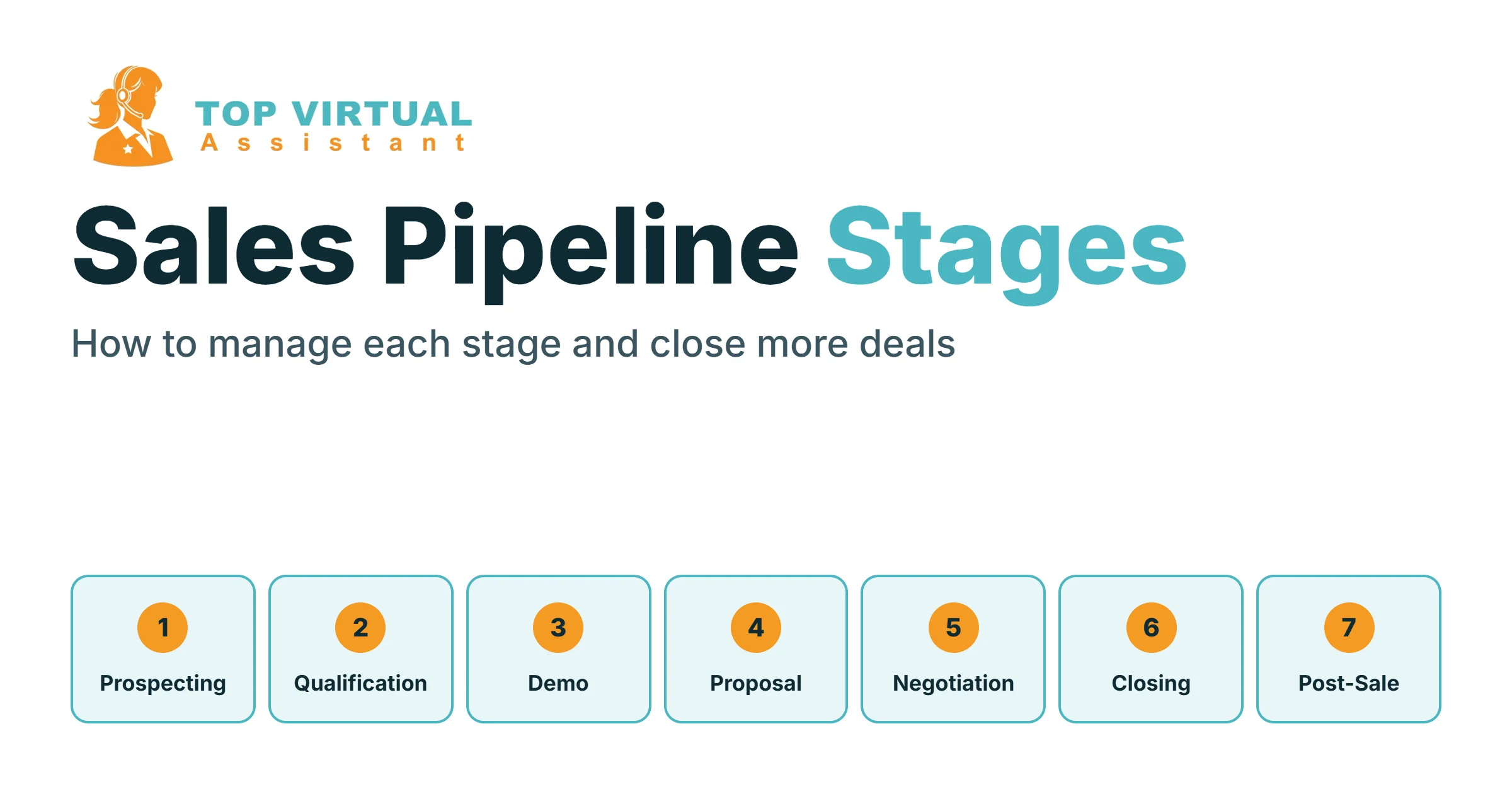
Sales pipeline stages are the steps a prospect moves through from first contact to a closed deal. The typical sales pipeline stages are: prospecting, qualification, discovery or demo, proposal, negotiation, closing and, optionally, post-sale follow-up. To manage each stage well, define clear entry and exit rules, track the conversion rate between stages and act quickly on deals that stall.
Most sales teams do not have a lead problem first. They have a visibility problem. Deals sit in the wrong stage, follow-ups slip and nobody can say which stage is leaking revenue. Clear sales pipeline stages fix that by giving every deal a position, a next step and an owner.
In this guide, Top Virtual Assistant (TVA) explains what are the sales pipeline stages, how to manage each stage, which pipeline stages are most critical, how B2B and SaaS pipelines differ, how CRM pipeline stages work, which metrics to track and how to improve conversion rates from one stage to the next.
Key Takeaways
- Sales pipeline stages are checkpoints a deal must pass, shown on a visual board.
- Most B2B pipelines use five to seven stages. The number matters less than having clear rules for moving a deal forward.
- Every stage needs an entry rule, an exit rule, an owner and a metric.
- Conversion rate between stages shows where you lose deals. Fix the weakest stage first.
- The most critical pipeline stages are usually qualification, proposal and negotiation, but your own conversion data should decide where to focus.
- A healthy pipeline starts with enough qualified prospects, which is where sales development support helps most.
What Is a Sales Pipeline?
A sales pipeline is a visual representation of where every potential customer stands in your sales process. It shows which deals are open, which stage each one is in, how much each deal could be worth and what needs to happen next. In business terms, the pipeline is the working view of your future revenue.
The pipeline is different from a sales process. The sales process is the set of actions your team takes. The pipeline is the map that shows how many deals are at each point in that process.
What Is a Sales Pipeline Stages?
A sales pipeline stage is one step in the buyer’s journey from first contact to closing, and it represents a specific milestone that must be reached before a deal moves forward. For example, a deal moves from “qualification” to “demo” only after you confirm the prospect has a need, a budget range and the authority to buy. In a CRM, these steps are called CRM pipeline stages or sales stages in CRM, and many teams simply call them sales stages.
Good stages describe what the buyer has done, not what the seller hopes will happen. “Prospect agreed to a demo” is a clear stage. “Feeling positive” is not.
Pipeline Stages vs Sales Stages
People use sales stages and pipeline stages almost interchangeably, but there is a small difference. Sales stages describe the steps of your selling process, such as discovery or negotiation. Pipeline stages are the same steps as they appear on your CRM board, where each open deal sits in exactly one stage. When your sales stages are written clearly, your pipeline stages are easy to build and easy to report on.
What Are the Stages of a Sales Pipeline?
The most common sales pipeline stages are prospecting, qualification, discovery or demo, proposal, negotiation and closing, with post-sale follow-up added as a final stage by many teams. If you only need the short version, the five core stages are prospecting, qualification, proposal, negotiation and closing.
| # | Stage | Goal | Typical Exit Rule |
| 1 | Prospecting | Find and contact potential buyers | Prospect replies or shows interest |
| 2 | Qualification | Confirm need, budget, authority and timing | Prospect fits your ideal customer profile |
| 3 | Discovery / Demo | Understand the problem and show your solution | Prospect agrees the solution fits |
| 4 | Proposal | Send a clear offer and price | Proposal reviewed by decision makers |
| 5 | Negotiation | Handle objections, terms and pricing | Terms agreed in principle |
| 6 | Closing | Get the signature or payment | Contract signed or payment made |
| 7 | Post-sale | Onboard, support and look for renewal or upsell | Customer onboarded successfully |
Your own pipeline may use different names. A service business might use “discovery call” and “quote sent”, while a software company might use “trial started”. What matters is that each stage is clear and measurable. The best sales pipeline stages are the ones that match how your buyers actually buy, describe a clear buyer action and can be measured.
Use this table as a starting point for your own sales pipeline stages.
How to Manage Each of the 7 Sales Pipeline Stages
The first of the sales pipeline stages is prospecting.
Stage 1: Prospecting
Goal: Build a steady supply of potential buyers who match your ideal customer profile.
How to manage it:
- Write a clear ideal customer profile (industry, company size, job titles, pain points)
- Build verified lists and contact prospects through email, LinkedIn and calls
- Log every contact in your CRM so nothing is lost
- Track how many prospects you contact each week and how many reply
Metric to watch: reply rate and number of new qualified conversations per week.
Common mistake: Founders and senior reps spend their best hours prospecting. Many teams hand this stage to a sales development rep or a lead generation assistant, and you can read how in our guide on how to outsource lead generation.
Stage 2: Qualification
Goal: Decide quickly whether a lead is worth your sales team’s time.
How to manage it:
- Use a simple checklist such as BANT: budget, authority, need and timing
- Ask the same core questions on every first call.
- Track lead pipeline stages (new lead, contacted, engaged, qualified) so every lead has a clear status.
- Move unqualified leads out of the pipeline instead of letting them clog it
- Set a rule for when a lead becomes a sales-qualified lead, where marketing pipeline stages such as awareness, lead capture and nurture end and the sales pipeline begins.
Metric to watch: lead-to-qualified conversion rate.
Common mistake: Keeping weak leads “just in case”, which makes the pipeline look bigger than it is.
Stage 3: Discovery and Demo
Goal: Understand the buyer’s problem deeply and show how your offer solves it.
How to manage it:
- Ask more questions than you answer in the first half of the call
- Tailor the demo to the problems the prospect mentioned
- Identify every decision maker and ask how they will decide
- Agree on a next step before the call ends
Metric to watch: qualified-to-demo conversion rate and demo show-up rate.
Common mistake: Giving the same generic demo to every prospect.
Stage 4: Proposal
Goal: Present a clear offer that makes the next step easy. The proposal is where many sales pipeline stages stall.
How to manage it:
- Send the proposal quickly, ideally while the conversation is fresh
- Restate the buyer’s problem, your solution, the price and the timeline
- Offer two or three options when it makes sense
- Follow up within a set number of days
Metric to watch: time from demo to proposal and proposal-to-negotiation rate.
Common mistake: Sending a proposal and waiting without a follow-up plan.
Stage 5: Negotiation
Goal: Resolve objections about price, scope and terms without giving away value.
How to manage it:
- Know your minimum terms before the conversation starts
- Trade concessions instead of giving them away (for example, a discount for a longer contract)
- Involve the decision maker early
- Document everything agreed
Metric to watch: average discount given and negotiation-to-close rate.
Common mistake: Cutting the price at the first objection.
Stage 6: Closing
Goal: Turn the verbal agreement into a signed contract or payment.
How to manage it:
- Make the contract and payment steps simple
- Set a clear closing date and follow up the day before
- Handle last-minute concerns directly
- Update the CRM immediately as won or lost, and record the reason
Metric to watch: win rate and average sales cycle length.
Common mistake: Not recording why deals were lost, which wastes the best learning data you have.
Stage 7: Post-Sale
Goal: Make the customer successful so they stay, renew and refer others.
How to manage it:
- Hand over cleanly from sales to onboarding or support
- Check in after the first 30 days
- Ask for feedback, reviews and referrals
- Flag upsell and renewal opportunities
Metric to watch: onboarding completion, retention and referral rate.
What Are the Best Sales Pipeline Stages?
There is no single set of best sales pipeline stages for every business. The best stages are the ones that match how your buyers actually buy and that your team can apply the same way every time. A good set of stages passes four tests:
- Each stage describes something the buyer has done, not how the seller feels.
- Each stage has a written entry rule and exit rule.
- Stages follow a logical order, and a deal sits in only one stage at a time.
- You can measure the conversion rate from each stage to the next.
Start with the seven-stage table above. If your sales cycle is very short, merge discovery and proposal. If it is long and complex, add review stages such as technical or legal review.
B2B Sales Pipeline Stages: What Changes?
B2B sales pipeline stages are usually longer and more detailed than consumer pipelines because several people are involved in the buying decision and the sales cycle takes more time. The core stages are the same, but you should adjust them in these ways:
- Multiple decision makers: Track every stakeholder, not just your main contact.
- Longer cycles: Add stages such as “technical review”, “security check” or “legal review” if your buyers always go through them.
- More touchpoints: Plan follow-ups across email, calls and LinkedIn instead of relying on a single channel.
- Higher deal value: Qualify more carefully, because each deal takes more time and resources.
Sales Pipeline vs Sales Funnel
| Factor | Sales Pipeline | Sales Funnel |
| Focus | Deals and where they are in your process | Buyer behavior and how many people drop off |
| View | Seller’s view of open deals | Customer’s journey from awareness to purchase |
| Used for | Forecasting, deal management, sales coaching | Marketing and conversion analysis |
| Typical stages | Prospecting, qualification, proposal, closing | Awareness, interest, decision, action |
They work together. The funnel shows how many people enter and drop off, and the pipeline shows how each real opportunity is progressing.
Sales Pipeline Stages: Metrics That Matter
| Metric | What It Tells You |
| Stage conversion rate | The share of deals that move from one stage to the next |
| Win rate | The share of opportunities that become customers |
| Average deal size | The typical value of a closed deal |
| Sales cycle length | How many days a deal takes from first contact to close |
| Pipeline coverage | Pipeline value compared with your revenue target |
| Pipeline velocity | How fast revenue moves through your pipeline |
Pipeline velocity formula: (number of opportunities × average deal value × win rate) ÷ sales cycle length. For example, with 20 opportunities, an average deal value of 5,000, a 25 percent win rate and a 50-day cycle, velocity is (20 × 5,000 × 0.25) ÷ 50 = 500 per day. This is an illustration only, so use your own numbers.
How to Improve Conversion Rates Across Sales Pipeline Stages
- Find your weakest stage. Compare stage-to-stage conversion rates and fix the biggest drop first. Which pipeline stages are most critical? Usually qualification, proposal and negotiation-to-close, but the stage with the biggest drop in your own data is the one to fix first.
- Tighten qualification. Better leads at the top lift every stage below.
- Respond faster. Speed to reply and speed to follow up matter most in early stages.
- Use clear exit rules. Do not move a deal forward without a confirmed buyer action.
- Follow up on a schedule. Set follow-up tasks for every deal so none are forgotten.
- Personalize the demo and proposal. Use the buyer’s own words and problems.
- Review stalled deals weekly. Re-engage, reset the next step or close them out.
- Record loss reasons. Patterns in lost deals show what to change in your pitch, pricing or targeting.
- Free up selling time. Move research, list building and CRM data entry to support staff so closers can sell.
Does HubSpot Automate Sales Pipeline Stages?
Yes, CRM tools such as HubSpot let you create custom deal stages and use automation to create tasks, send notifications and update deal properties as deals move between stages. Salesforce and most other CRMs offer similar stage and automation features. The exact automation options depend on the plan you choose, so check your plan before you build workflows. In any CRM, CRM pipeline stages are the sales stages in CRM that each deal moves through, so they should match the steps your team really follows.
When choosing a CRM for a small business, look for these pipeline features:
- Customizable deal stages and probability settings
- A visual drag-and-drop pipeline board
- Automated reminders and follow-up tasks
- Email and call logging
- Reports on conversion rates, win rate and sales cycle length
- Simple forecasting
Whatever CRM you use, the best practice is the same: keep stages simple, make stage definitions mandatory and clean the data weekly.
Best Practices for Managing Sales Pipeline Stages
- Keep to five to seven stages so the pipeline stays easy to read
- Define entry and exit criteria for every stage in writing
- Give every open deal a next step and a date
- Hold a short weekly pipeline review
- Remove dead deals instead of letting them age
- Track conversion rates by stage, source and rep
- Keep CRM data clean and complete
- Coach the stage where most deals stall
Common Mistakes in Sales Pipeline Stages
| Mistake | Why It Hurts | Fix |
| Too many stages | Reps skip or misuse them | Keep five to seven |
| Vague stage definitions | Deals move forward without real progress | Write entry and exit rules |
| No deal next step | Deals stall silently | Require a dated next step |
| Dead deals left open | Forecast becomes unreliable | Review and close out weekly |
| Weak top of pipeline | No amount of closing fixes low volume | Invest in prospecting and qualification |
| Not tracking loss reasons | The same mistakes repeat | Record a reason for every lost deal |
Fill the Top of Your Pipeline with TVA
A pipeline only works if there are enough qualified prospects entering it. At Top Virtual Assistant (TVA), our sales development team supports prospecting, list building, outreach and appointment setting, so your closers can focus on the later sales pipeline stages. You can also explore a dedicated SDR, an outbound calling agent or our pricing options.
Want more qualified conversations in your pipeline? Start your free trial with TVA →
Frequently Asked Questions
What is a sales pipeline stage? A sales pipeline stage is a step in the buyer’s journey, such as qualification or proposal, that a deal must reach before moving forward. Each stage has clear entry and exit rules.
What are the stages of a sales pipeline? The common stages are prospecting, qualification, discovery or demo, proposal, negotiation, closing and post-sale follow-up. Your own pipeline may use different names or fewer stages.
What are the 5 stages of a sales pipeline? The five core stages are prospecting, qualification, proposal, negotiation and closing. Many teams add discovery or demo and post-sale stages.
How many stages should a sales pipeline have?Most teams use five to seven stages. Fewer stages are easier to manage, and more stages can give extra detail for long B2B sales cycles.
What is the difference between a sales pipeline and a sales funnel? The sales pipeline tracks individual deals through your sales process, while the funnel describes how many buyers move from awareness to purchase and where they drop off.
How do you manage a sales pipeline? Define each stage clearly, give every deal a next step, review the pipeline weekly, track conversion rates and remove stalled or dead deals.
Does HubSpot automate sales pipeline stages?Yes. HubSpot lets you set up deal stages and use workflows to create tasks, send alerts and update deal data automatically. Available automation depends on your plan.
How do I improve conversion rates across sales pipeline stages? Find the stage with the biggest drop, tighten qualification, follow up faster, use clear exit rules, personalize demos and proposals and record why deals are lost.
What are B2B sales pipeline stages? B2B sales pipeline stages follow the same core steps but often add extra stages for technical review, legal review or several decision makers, because B2B deals take longer and involve more people.
What is pipeline velocity? Pipeline velocity measures how quickly deals generate revenue. It is calculated as number of opportunities multiplied by average deal value and win rate, divided by sales cycle length.
What are the names of the five sales pipeline stages, and what do they mean? The five core stages are prospecting (finding buyers), qualification (checking fit), proposal (making the offer), negotiation (agreeing terms) and closing (getting the signature or payment).
Which sales pipeline stages are most critical? Qualification, proposal and the negotiation-to-close steps usually matter most. The most critical stage for you is the one with the biggest drop in conversion rate.
What are the best sales pipeline stages? The best stages describe real buyer actions, have written entry and exit rules and can be measured. For most teams, five to seven stages work well.
What are SaaS sales pipeline stages? They usually run from lead or sign-up to sales-qualified lead, demo, trial, proposal, negotiation and security review, closed won and onboarding.
What are business development pipeline stages? They usually run from research and outreach to a discovery meeting, proposal, negotiation, signed agreement and relationship management.
What are marketing pipeline stages? Marketing pipeline stages track how a person becomes a lead: awareness, interest, lead capture, nurture and handoff to sales as a marketing-qualified lead.
What are lead pipeline stages? Lead pipeline stages show where a person stands before becoming an opportunity: new lead, contacted, engaged, qualified and disqualified or nurture.
What are CRM pipeline stages and sales stages in CRM? They are the stages you set up in your CRM so each deal sits in one clear position. Give each stage a name, entry and exit rules and a win probability.
Final Thoughts
Clear sales pipeline stages turn guesswork into a process you can measure and improve. Define each stage, write simple entry and exit rules, track conversion rates and review your sales pipeline stages every week and fix the weakest one first.. Then strengthen the top of the pipeline, because even a perfect process needs a steady flow of qualified prospects.
The goal is simple: know exactly where every deal stands, and what has to happen next.
